
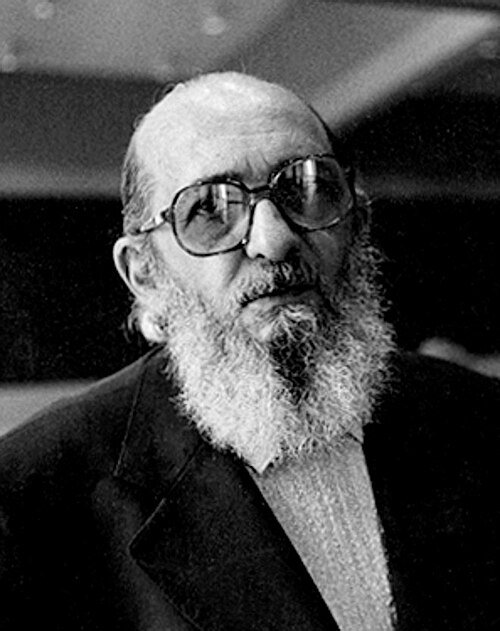
Paul Freire, 1977; image from wikipedia, creative commons license. https://en.wikipedia.org/wiki/Paulo_Freire
Paul Kirschner is passionate about introducing research to teachers; research that should be part of their preservice training or continuing professional development, but too often is not. Kirschner relishes the opportunity to point out the lack of research evidence behind many educational fads, and he’s unrelenting about busting persistent education myths. For all of these reasons, I respect and appreciate Kirschner and his work. His two books with Carl Hendrick, How Learning Happens and How Teaching Happens, introduced me to some seminal empirical literature related to teaching and learning that continue to influence my thinking.
Kirschner regularly gets frustrated with the way in which some educators misunderstand or misrepresent direct and explicit forms of instruction, which he points out (such as here), are the instructional approaches, when done well, that are best aligned to our human cognitive architecture, and are, therefore, often the most efficient and effective means of teaching and learning. In many respects, I do not disagree. However, Kirschner has sometimes been known to also mischaracterize the other side, those that he would call “progressive educators.”
On LinkedIn, Kirschner recently reposted a blog that he originally wrote in March 2025 called The Seductive Appeal of Discovery Learning. In other places, Kirschner has critiqued discovery-based learning, most famously in his 2006 article in Educational Psychologist, together with Sweller & Clark (Kirschner et al., 2006). In his March 2025 blog post he sought to explain why so many educators persist in their support for discovery-based learning despite the significant evidence that suggests it’s often ineffective for learning. In the blog post, Kirschner outlined ten reasons why he thinks the idea of discovery-based learning is appealing, despite being misguided. I agree with many of the reasons he lists; in fact, I wrote something similar recently (towards the end of this essay, I explained three reasons why I think teachers often neglect explicit “representations” of content). However, in his eighth reason for the appeal of discovery-based learning, Kirschner mentioned the influence of Paulo Freire. He argued that educators, under the influence of Freire have been anti-authority and, therefore, “from this perspective, explicit instruction became equated with indoctrination, while discovery learning was seen as a path to emancipation.”
I would agree with Kirschner that a discomfort with their own authority is a reason that some educators find discover-based learning appealing. They shy away from any role where they feel they are imposing their own knowledge constructions on the students. They embrace discovery-based learning as radical epistemological equality. Let the students construct their own understandings of the world free from any teacher influence. It sounds beautifully democratic, but, unfortunately, as Kirschner has pointed out, it’s not actually the way the human mind learns, especially the cognitively developing mind of children and adolescents in primary and secondary education.
Kirschner name-dropped several eduational theorists, probably doing a disservice to the corpus of work associated with each of them (Dewey and Illich), but it’s on his mention of Paulo Freire that I want to push back. I should make clear that, in his blog, Kirschner did not directly engage Freire’s work; rather he criticized some educators who have been influenced by Freire’s work. I agree that some who have encountered Freire have misread him or misapplied his ideas in their educational practices. In the context of how findings from cognitive science research are sometimes misapplied in the classroom, Kirschner has used the term “lethal mutations.” I think this term may apply to educator misunderstandings of Freire as well.
Below I want to discuss some of what Freire said himself. I’m going to draw primarily from a lesser known work of Freire’s from later in his life, Pedagogy of Hope. In Pedagogy of Hope (published in 1992; Freire died in 1997), Freire looked back on aspects of his life’s work; this included reflections on his most well known text, Pedagogy of the Oppressed. He used Pedagogy of Hope to engage critics of that work (some of which convinced him to refine his thinking, while other’s he refuted), to clarify some of his ideas in that book, and to correct some of the misinterpretations of his ideas.
Freire made it clear that he believed that teachers had, and needed to exercise, authority in the classroom. Freire made a clear distinction between exercising authority versus being authoritarian. He was absolutely anti-authoritarian, but he also believed that it was irresponsible of teachers to give up their role as teachers in the name of a liberatory pedagogy. He spoke strongly against, what he called, a permissive pedagogy in which teachers’ let students do whatever they want.
Freire was adamant that teachers’ need to respect and value the cultural knowledge the students bring with them to the classroom. This was partly a political position for Freire; his political perspective has sometimes been describe as one of radical humanist democracy. Just because the teacher may possess more knowledge related to the disciplinary content of that class does not mean that the teacher is the only knower in the room. In Pedagogy of Hope, Freire related the story of a game that he played with members of a rural community in northeast Brazil during his time of teaching adult literacy. The game involved each side (he was on one side and his audience of community members was the other side) attempting to stump the other with a question. The sides took turns posing questions. Freire’s questions focused on matters of philosophy or grammatical structure. The audience was unable to answer his questions. The community members, in their turns, asked questions related to their knowledge of their agricultural practices, suited to the local environment, climate and landscape. Freire was unable to answer their questions. The game ended in a tie of ten-to-ten. Of course, Freire’s point was that due to his study and university degrees, he possessed a certain type of knowledge, but due to their life experience, the audience members also possessed an important type of knowledge.
Freire’s position on teachers respecting and valuing students’ cultural knowledge was also partly epistemological; for Freire, knowledge is not transmitted in a one-way exchange from the teacher to the passively receiving, empty-vessel students. Rather, knowledge is reconstructed in the dialogical exchange between the teacher and the students, allowing the students to construct their own understanding of the object of knowledge. In order to create the conditions by which the students could construct their own understandings, for Freire, teachers need to be students of their students so as to help the students to begin from what they already know and construct their new and expanded understandings from there. In Pedagogy of the Oppressed, Freire referred to the dialogical teacher-student relationship as one of the teacher-student and students-teachers.
This seems to be where some readers of Freire misunderstand him. The dialogical relationship that Freire advocated did not mean that the teacher has no responsibility for directing the learning in the classroom. The teacher is still the one with the disciplinary knowledge that defines the purpose for which that class has been assembled. Freire was a literacy teacher when he worked with these rural communities in northeast Brazil. He valued the cultural knowledge of his students, invested time and energy in learning about that cultural knowledge, and used that cultural knowledge as a starting point for his literacy instruction, but he certainly didn’t sit around in a circle waiting for his students to teach themselves how to read and write. In Pedagogy of Hope, Freire stated of the teacher, “she or he must begin with the educands’ ‘here’ and not with her or his own,“ and then a couple of lines later he continued:
“Let me put it this way: you never get there by starting from there, you get there by starting from some here. This means, ultimately, that the educator must not be ignorant of, underestimate, or reject any of the ‘knowledge of living experience’ with which the educands come to school” (italics in the original).
Notice the direction-oriented language that Freire uses. Yes, the teacher needs to begin with the knowledge the students already possess (the here), but that is not the end-goal; there is a there to which the learning is oriented. Just a few pages later, Freire clarifies the implications of his epistemology for teaching with the following:
“I cannot resist repeating: teaching is not the pure mechanical transfer of the contour of the content from the teacher to passive, docile students. Nor can I resist repeating that starting out with the educands’ knowledge does not mean circling around this knowledge ad infinitum. Starting out means setting off down the road, getting going, shifting from one point to another, not sticking, or staying” (italics in the original).
Implied in Freire’s epistemology is that teachers’ bare the responsibility, the authority, for directing the learning from the students’ here to the there. Earlier in Pedagogy of Hope, at the outset of this here and there discussion, Freire makes that explicit when he writes of the teacher, “…the educator’s dream is not only to render his or her ‘here-and-now’ accessible to the educands, but to get beyond their own ‘here-and-now’ with them…”
Elsewhere in Pedagogy of Hope, Freire responds more directly to those who have misinterpreted his ideas as a permissive pedagogy where teachers must abdicate their role as teachers. In this section, Freire draws a distinction between authoritarianism and authority. For example, he writes:
“Let me repeat: there is no educational practice without content. The danger, of course, depending on the educator’s particular ideological position, is either that of exaggerating the educator’s authority to the point of authoritarianism, or that of voiding of the teacher’s authority that will mean plunging the educand into a permissive climate and an equally permissive practice.”
Just a little further on in the text, referring to the risk of “voiding of the teacher’s authority,” he continues:
“Devoid of limits, spontaneous practice, which shreds to pieces something so fundamental in human beings’ formation — spontaneity — not having sufficient strength to deny the necessity of content, nevertheless allows it to trickle away in a never-justifiable pedagogical ‘Let’s pretend.’”
In these passages, Freire makes clear that education implies content-objectives. The students are in that classroom with a purpose; there is a direction, there is a goal, there are objects of knowledge for the students to come to understand. Furthermore, it is the teacher’s duty to exercise his or her authority for the purpose of directing the learning towards those content-objectives.
Before concluding, I want to quote something from Freire in another text, We Make the Road by Walking, which was published in 1990 as an edited dialogue between Freire and Myles Horton, founder of the Highlander Folk School in the US. In chapter four of that book, Freire elaborates on his distinction between teacher authority and authoritarianism. Because of the conversational nature of the book, this passage perhaps provides a clearer explanation of Freire’s views. He writes:
“While having on one hand to respect the expectations and choices of the students, the educator also has the duty of not being neutral, as you said . The educator as an intellectual has to intervene. He cannot be a mere facilitator… one of the mistakes we can commit in the name of freedom of the students is if I, as a teacher, would paralyze my action and my duty to teach. In the last analysis, I would leave the students by themselves, and it would be to fall into a kind of irresponsibility. At this moment, afraid of assuming authority, I lose authority. Authority is necessary to the educational process as well as necessary to the freedom of students and my own. The teacher is absolutely necessary. What is bad, what is not necessary, is authoritarianism, but not authority.”
My goal in taking a closer look at Freire’s own words was twofold: first, to ensure that Kirschner’s reference to Freire doesn’t give his readers the impression that Freire was an advocate of discovery-based learning; second, to encourage other readers of Freire to take a closer look at what he thought about teachers’ authority. Freire definitely aligned with the politics of the left. He was influenced by Marx, Erich Fromm, Frantz Fanon, Gustavo Gutierrez and others. In this, I suspect that Kirschner and Freire share little in common. However, on Freire’s epistemology — which I would argue was in close step with a cognitive constructivist view — and how that influenced what he saw as the role of the teacher, it’s possible that Kirschner, with some closer reading, may find some common ground. Let me close with this passage from Freire’s Pedagogy of Hope, which, I think, rings very close to Lee Shulman’s notion of the teacher’s job of transforming the subject matter to render it comprehensible to the students. It also clearly does not describe a minimally-teacher-guided, discovery-based learning situation.
“For their part, teachers teach, in authentic terms, only to the extent that they know the content they are teaching— that is, only in the measure that they appropriate it, that they learn it, themselves. Here, in teaching, the teacher re-cognizes the object already cognized, already known. In other words, she or he remakes her or his cognizance in the cognizance of the educands. Thus, teaching is the form taken by the act of cognition that the teacher necessarily performs in the quest to know what he or she is teaching in order to call forth in the students their act of cognition as well. Therefore, teaching is a creative act, a critical act, and not a mechanical one.”
References
Horton, M. and Freire, P. (1990). We make the road by walking: Conversations on education and social change. Temple University Press.
Freire, P. (2021). Pedagogy of hope: Reliving pedagogy of the oppressed. Bloomsbury Academic.
Freire, P. (2000). Pedagogy of the oppressed (30th anniversary edition). Continuum.
Kirschner, P. and Hendrick, C. (2020). How learning happens: Seminal works in educational psychology and what they mean in practice. Routledge.
Kirschner, P, Hendrick, C. and Heal, J. (2022). How teaching happens: Seminal works in teaching and teaching effectiveness and what they mean in practice. Routledge.
Kirschner, P., Sweller, J. and Clark, R. E. (2006). Why minimal guidance during instruction does not work: An analysis of the failure of constructivist, discovery, problem-based, experiential, and inquiry-based teaching. Educational Psychologist, 41(2), 75–86.
Shulman, L. (1987). Knowledge and teaching: Foundations for a new reform. Harvard Educational Review, 57(1), 1–22.
