
Some Reflections on Ed Tech After Reading The Digital Delusion by Jared Cooney Horvath (Part 1)
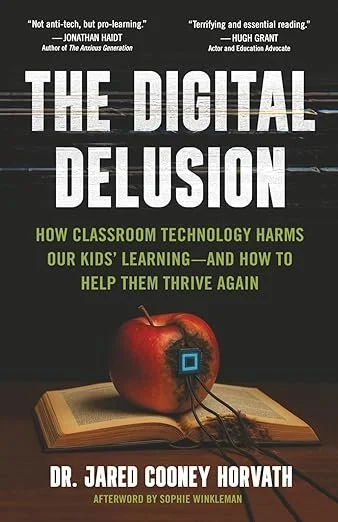
Cover of The Digital Delusion by Jared Cooney Horvath
The Digital Delusion: A Critique of Education Technology
Discussions about AI in education are everywhere these days. It’s a topic on which I’ve been doing some reading and thinking lately. In that context, I recently finished reading the new book by Jared Cooney Horvath called The Digital Delusion. What follows are some of my reflections on Ed Tech, which had been brewing already, but have come into greater focus following my reading of Horvath’s book. I’ll use Horvath’s term, “Ed Tech,” throughout this post; he uses it as a catch-all term for digital and internet-connected education tools and devices. Horvath’s book is divided into three parts; he develops his critique in parts 1 and 2, while part 3 consists of recommendations and resources for how different stakeholders can respond. For me, parts 1 and 2 elicited different reflections, so I’ll focus on part 1 in this post, and in a subsequent post, on part 2.
Horvath’s book is not just about AI in education, though he devotes a couple of chapters in part 2 specifically to AI tools. Horvath situates his critique of AI in education within a larger context of Ed Tech tools in general. I appreciate Horvath’s approach to look critically at Ed Tech broadly. Many proponents of Generative AI argue that it’s just the latest in a long line of human-built transformative technologies. They argue that we’ll adapt to these tools just like we did to the printing press, the steam engine, the automobile, the computer, the internet, and mobile phones. They say things like, “every new technology initially creates a disturbance,” or “as with previous technological developments, there will be winners and losers, but the net impact will be positive.” Related to education, AI advocates say: “students have always found ways to use tools to cheat,” or “teachers panicked in the same way about the internet, but they adjusted.” It even seems that everyone remembers Socrates these days; I’ve heard several references to his skepticism of the invention of writing as an example of misguided change aversion among educators. According to those championing Gen AI, we’ll look back on those who are panicking about it today much like we look at the Luddites of the early 19th century in Great Britain; they will be remembered as a quaint, fringe group who were unwilling to change with the times.
I’m not convinced by this argument about Generative AI; I think these new tools will create much greater disruption in education than previous technologies. But, if the AI proponents are going to argue that these inventions are just the latest in a line of technological progress, I think Horvath is wise to engage that as an honest perspective and, rather than focusing just on AI tools, pursue a critical look at the role of Ed Tech as a whole.
Not Anti-Tech, But Increasingly a Skeptic
Though his book is definitely critical of Ed Tech, Horvath claims that he is not anti-technology. I too am not anti-tech; in fact, I have embraced a lot of it throughout my career. My first classroom was equipped with a Smartboard and I used it daily. I’ve been part of one-to-one laptop schools since 2012; I’ve used multiple Learning Management Systems (LMS) including Moodle, Google Classroom, Toddle, and Schoology. I’ve had students use digital tools for projects including some cool digital mapping and remote-sensing imagery projects in geography (Google Earth & ArcGIS). I’ve depended on the Google suite of tools (Docs, Slides, Forms, etc.) for nearly every lesson. I taught a high school stats class where we did all sorts of things with Google Sheets. I taught a personal finance class where we used digital simulation games, including a semester-long, stock-market trading simulation. I’ve had students use Canva for info-graphic poster projects, create and edit their own videos, and organize research projects using NoodleTools. Several years ago I stopped having students do live classroom presentations and started having them screen-record their presentations and submit the video files. I taught through the Covid pandemic, so did lots of stuff with Zoom and Google Meet, and screen-recorded lots of instruction during those years. At different points I’ve used EdPuzzle, Quizlet, Kahoot, Padlet, and Flipgrid. I’ve also done some experimenting with students with deliberate integration of AI tools into learning and projects. Rather than being anti-tech, I’ve become dependent on it; on days when the internet goes down at my school, I struggle to keep the class going.
But recently I’ve been growing a little disillusioned with the role of digital technology in education and it’s impact on student learning. I’ve grown increasingly frustrated with the way in which digital devices — laptops, Chromebooks, tablets, not mention phones — present competition for student attention in the classroom, often distracting from learning, rather than contributing to it. Last year I found myself increasingly returning to whiteboards (both at the front of the room and mini whiteboards on student desks), notebooks, and hard-copy readings. I’ve found that Ed Tech often makes great claims about engaging students and enhancing learning — claims that have increased exponentially since the release of Generative AI tools — but I’ve become more skeptical of these promises.
Progressive Education and Educational Technology
Throughout my career I’ve taught in schools that would probably embrace the descriptor of “progressive education.” By “progressive,” I mean that they’ve been schools where most of the leaders and teachers have felt the need to change, adapt, and improve teaching and learning, because the ways of schooling in the past were probably never great, and certainly aren’t adequate and appropriate for the world we live in today or the futures our students will face. By this definition, I would also accept the label of being a progressive educator. I entered the teaching profession partly because I thought school had been done poorly for much of my K-12 education and I wanted to contribute to doing it better. I fear, however, that progressive education has been taken in by the promises of Ed Tech. Though this list is probably not exhaustive, I can think of three reasons why progressive education has embraced Ed Tech uncritically.
There is one reason that is perhaps the simplest, so I’ll address that first. Tech companies are in the business of making money and they see schools as a large potential market for their products. As such, they invest significant marketing budgets into convincing educators of the power of their tools for transforming student learning. Educators want to appear innovative, so they often embrace these Ed Tech tools because they look cool, produce great looking products, and promise to improve learning for students. Despite being untested and regardless of the limited data on their impacts, educators are often sold on the Ed Tech marketing pitch.
The next two reasons are more complex and get a little more political. The second reason relates to my statement above about educators — particularly, progressive educators — wishing to appear innovative. I think that progressive education — much like a lot of progressive spaces — has become too captured by neoliberalism. Many schools have become too focused on what students need for success in the global marketplace. Schools often obsess over predictions of what skills and aptitudes students will need for the future world of work, whether employment or entrepreneurship. Since tech is such a driving force of global economic growth, while it is also dramatically changing labor demands, progressive schools feel compelled to embrace technology in order to prepare students for this economic future. I believe they sometimes do this at the expense of knowledge, thinking, cognitive development, and moral maturation.
A third reason is that progressive schools have long seen personalization as the holy grail of education. The goal of personalized learning is that each student’s learning pathway would be customized to them, factoring for their unique interests, culture, ability, background, prior knowledge, pace, etc. Advocates of personalized learning argue that this level of customization would enhance the learning of each student, and it would promote student ownership over their own learning, helping to forge life-long learners who can continue to learn and adapt in an ever-changing world. The challenge of this personalized learning goal, is that it’s impossible for human teachers to facilitate and manage that level of customization with 20-30 (or more) students per class, and multiple classes per day. Here enter the assurances of Ed Tech.
Ed Tech promises to do what human educators cannot; it promises to make personalized learning possible for each student. This has long been a rationale for educators embracing technology in the classroom, but it’s one of the main arguments for newer AI-driven Ed Tech tools. Companies are marketing these tools to schools as individual AI-tutors where each student will have their own one-to-one teacher to answer their questions, create personalized learning experiences, and provide targeted feedback.
I support inclusive learning that considers the differences of individual students; good teaching needs to be adaptive to the students in the room. However, I’m concerned that this personalization goal is also one influenced by the maximum individualism of neoliberalism. It feels a little like we’re encouraging students to become atomized learning consumers. I fear that what is lost are the human interpersonal, social elements of learning that have been key to human cognitive development and the progress of human knowledge and culture for millennia. My concern is magnified by the effort to achieve this goal of personalization via non-human AI tutors.
Highlights from Horvath’s The Digital Delusion
The above analysis of why progressive education has embraced Ed Tech is mine, but it aligns with some of Horvath’s points in his book. In part one of The Digital Delusion, Horvath first sets out to debunk five myths that undergird Ed Tech’s influence in education. I’ve definitely heard versions of these myths within schools where I’ve worked, so I think his myth-busting chapter is worthwhile reading.
In chapter 2, Horvath reviews the data on the impact Ed Tech has had on learning. I think this is actually one of the weaker chapters. Some of the data he discusses are just correlational; we can’t definitively point to the role of Ed Tech as a cause of declining international academic achievement test scores, for instance. I can also hear the counter argument questioning the validity of those tests for the type of learning students do in schools today. Horvath also cites some John Hattie meta-analysis data, which indicates that Ed Tech interventions, on average, do not meet the threshold for effective effect sizes. While this is data worth considering, again I can hear the other side pointing out the debates over meta-analysis effect size methodology. Nonetheless, given the lofty promises of Ed Tech, it’s worth noting that good research data demonstrating its positive impact on student learning is limited, while there is important data suggesting that the impact of Ed Tech on student learning may be weak at best, and even negative at worst.
Given that he’s a neuroscientist, I think Horvath is at his best in chapter 3 where he discusses the ways in which Ed Tech often operates contrary to the neurological mechanisms of learning in the human brain. He first discusses the way in which a lot of Ed Tech fractures student attention, undercutting the mental focus necessary for their learning. This is perhaps the key reason that I’ve grown frustrated with a lot of Ed Tech. Yes, theoretically, there are many cool things you can do with an internet-connected personal laptop or tablet in the hands of each student in the classroom. However, I have found that the device in front of them is very drug-like in it’s addictiveness for many students. Even when students have the best of intentions for the use of that device, many will open it and, within minutes, find themselves down a distracting rabbit hole of games, videos, and chats. (And it’s not just students; I have often stood in front of a group of teachers during a meeting or PD session and experienced the exact same issue.)
Horvath’s discussion of the need for affective empathy in human learning is another potent critique of Ed Tech. He emphasizes that a tech tool cannot generate or prompt affective empathy because, at it’s base, empathy is a biological interaction — called physiological synchrony — between two or more biological beings. Horvath argues that “empathy supports understanding” and “fuels motivation,” both of which are vital for student learning, and both of which are lacking without an interaction between biological entities. Horvath believes this is why the rate of incompletion for online courses is around 85%, and why students learning online tend to underperform compared to those learning in person.
Conclusion for Part 1
Overall, though I wasn’t convinced by each of his points, I found Horvath’s critique of Ed Tech compelling in part 1. I probably won’t give up the use of all Ed Tech tools in my classroom. I will probably still have students use different digital technologies for project-based assessments. I will probably continue to have students video-record presentations of their learning. I will probably continue to use my school’s LMS to push-out materials and resources to students, while having student submit things to me. I will likely even incorporate AI tools into my classes at points. However, I think going forward I will be much more deliberate about what Ed Tech tools I use in the classroom and when. I will think critically about their value for student learning. I will seriously consider the opportunity costs when using Ed Tech tools in terms of competition for student attention and obstacles to interpersonal empathy. I anticipate that I’ll have more classes in the future where student laptops / tablets remain closed for the whole lesson. I even expect I’ll have students taking notes with a pen in a notebook more often.
If for no other reason, I recommend that teachers and school leaders read Horvath’s book as a counter-balance to the ubiquity of promises from Ed Tech. I think the corrective nature of this book is especially needed in our current time where AI companies are pushing hard into education spaces. We could all benefit from a more critical lens on the role of AI in education and the impact of Ed Tech more broadly.
Stay tuned for my part 2 reflections coming soon.
