
Resolving Teachers’ Suspicion of Educational Research and Outside Expertise
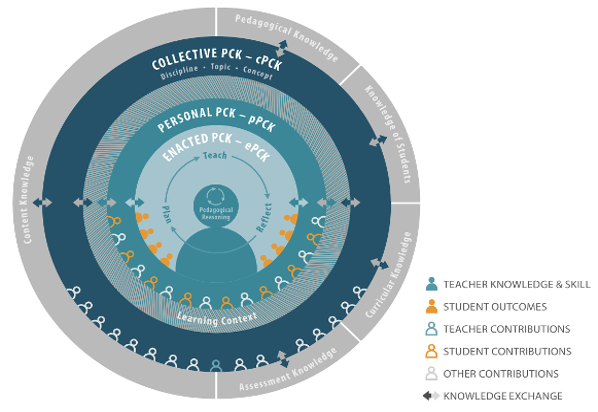
The Refined Consensus Model (RCM) of Pedagogical Content Knowledge (Carlson et al., 2019).
What follows is something I wrote a few months ago. It started as an analytic memo that I wrote during my Ed.D. Capstone research, but it ended up as a bit of a side-trail from my research focus. Those who are a little familiar with my recent research interests will recognize the familiar topic of Pedagogical Content Knowledge, or PCK. Those who read my recent article in the TIE Newsletter will also recognize the description of the Refined Consensus Model of PCK as a model of teacher professional knowledge and professional learning. While in previous writing, I’ve focused on the “bottom-up” knowledge construction about teaching by teachers, in this post I note that teacher professional knowledge develops in both directions, from the “inside-out,” but also from the “outside-in.”
Teacher Suspicion of Outside Education Expertise
I’ve been a secondary teacher for 18 years. During those years, I’ve found that many teachers tend to be suspicious of education researchers and experts. I don’t think I’m just projecting here; though I will admit that when it comes to education experts, I’ve often maintained a suspicious attitude myself. I think there are several legitimate reasons for this suspicion in teachers. First, though teaching requires formal education and a licensure process, much about teaching involves craft knowledge acquired through experience on the job. There is certainly value in the university pre-service programs that prepare teachers, but many teachers look back and feel that they didn’t really learn to teach until they were thrown into a classroom to do it. Though I think it’s misguided when teachers question the benefit of what they learned from the experts in their pre-service programs, given the apprenticeship nature of the teaching craft, I also understand the perspective.
A second reason for teacher suspicion of education experts relates to their experience with in-service professional development (PD). Too much teacher PD is presented to teachers a) without valuing the knowledge and experience of the teachers and b) without a connection to the teachers’ everyday classroom contexts and practices. For teachers, many of the experts involved in leading PD are out of touch with the realities of daily teacher life in the classroom.
The suspicions of teachers are sometimes justified. There are plenty of examples of PD initiatives that fail because they were not created or tested with real classroom contexts in mind, or the experts presenting the initiatives simply lack credibility with the teachers because of their detachment from real classrooms. Despite these justifications, there are problematic consequences of teachers dismissing outside expertise in the field.
Consequences When Teachers Dismiss Outside Expertise
Many teachers rarely engage with educational research, some of which is very useful. Many teachers continue with instructional practices despite research that demonstrates that they are ineffective. Teachers are often susceptible to their own cognitive biases regarding what works and what doesn’t in the classroom. Some teachers are prone to follow education fads and trends that lack any research basis. Teachers even fall prey to education myths that are either weakly supported by research, or completely contrary to it. Learning styles, the learning pyramid, multi-tasking, left- vs. right-brain-dominance, discovery-learning, digital natives– these are all examples of education myths that teachers often believe because they ignore education research expertise (Bruyckere et al., 2015, 2020).
Pedagogical Content Knowledge as Teacher Professional Knowledge
This issue relates to the nature of teacher professional knowledge. What knowledge is required to be an effective teacher? From what sources can teachers acquire this knowledge? How does this knowledge develop? How much of the professional knowledge for teaching must come from the outside-in, and how much is derived from bottom-up teaching experience?
I’ve recently been exploring the concept of Pedagogical Content Knowledge (PCK); I’ve found it a helpful way of understanding teacher professional knowledge. PCK was a theory first articulated in the 1980s by Lee Shulman (1986) who coined the term to describe what he believed was the unique professional knowledge of teachers. Shulman (1986, 1987) understood PCK to be a form of applied knowledge that drew on teachers’ content knowledge and pedagogical knowledge but arose from the context of actual teaching practice with specific students in real classrooms. For Shulman (1987), it is teachers’ PCK that enables them to transform subject matter into pedagogical forms that will make it comprehensible to the specific students in the classroom. Three decades of research on PCK since Shulman, carried out primarily in the field of science education, contributed to the Refined Consensus Model (RCM) of PCK, published in 2019 (Carlson et al., 2019).
The Refined Consensus Model of PCK
The RCM of PCK helpfully depicts the nature of teacher professional knowledge as well as the sources and pathways that contribute to its development. I think the RCM also helps to resolve the tension in K-12 education between the knowledge produced by outside experts versus the knowledge gained through teachers’ practice in the classroom. The RCM of PCK, as depicted in Carlson et al. (2019), is shown below and in the image at the top of this post. Below I briefly describe it and explain its implications for teacher professional knowledge.
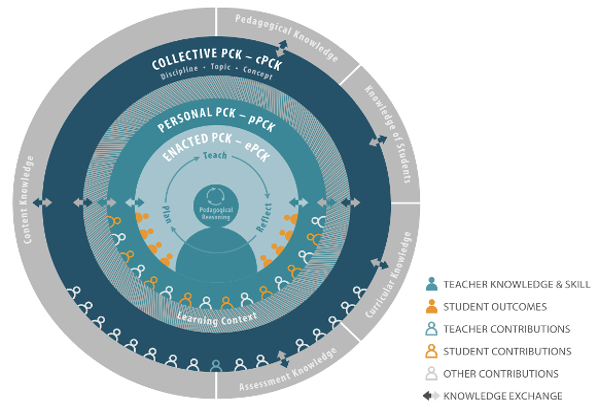
The Refined Consensus Model of PCK (Carlson et al, 2019).
Moving from the outside-in of the concentric-circle RCM model, the outermost circle represents the various knowledge domains that are necessary for teaching. These are the knowledge domains commonly developed during teacher pre-service training, and they are often the focus of teacher in-service PD. These include knowledge of the content of a subject-area, pedagogical knowledge, including pedagogical strategies and assessment methods, knowledge of the curriculum in K-12 schools, and general knowledge of students, such as how students learn and the psychology of their social, emotional, and cognitive development.
The next circle represents the collective knowledge of teachers of the same subject-matter. It’s PCK in the sense that it’s been derived by teachers through teaching, but at this level, the knowledge is general; it’s knowledge that’s been abstracted beyond a specific teaching and learning context. This gets at the constructivist nature of knowledge assumed in the theory of PCK (Cochran et al., 1993; Park et al., 2011; Park & Chen, 2012; Park & Oliver, 2008; Tallman, 2023). For constructivists, people can communicate what they know and hold common understandings with others, but, ultimately, knowledge is always a personal construction within the mind of the knower. From this constructivist perspective, collective PCK (cPCK) represents the similar knowledge constructions of a group of individuals who teach the same subject-matter.
As we cross the learning context threshold of the RCM and move into specific classrooms with individual teachers, the next circle on the RCM represents the individual teacher’s personal-PCK (pPCK). Further in, the inner-most circle represents the individual teacher’s enacted-PCK (ePCK). To distinguish between these two inner circles of individual PCK, the researchers who developed the RCM borrow language from Schön’s (1983) work on professional knowledge (Carlson et al., 2019; Gess-Newsome, 2015; Park & Oliver, 2008); ePCK is derived from reflection-in-action, while pPCK forms through reflection-on-action. Teachers’ ePCK is the knowledge they demonstrate intuitively while teaching. It’s tacit, more automated knowledge, but it depends on the teacher’s more concrete and explicit pPCK. This is somewhat analogous to the expert ER doctor who can act and make decisions during a medical emergency largely by intuition but is only able to do so because of years of education, formal training, and practice.
At the same time, the relationship between ePCK and pPCK also goes the other way; teachers can develop explicit pPCK by taking a step back from their teaching practice to study it as an object of their own learning. This aligns with the work of Clarke and Hollingsworth (2002) who spoke of enactment and reflection as the two mediating factors for teacher professional growth. To grow professionally – to develop and refine their PCK – teachers must enact their PCK in the classroom and then step back in a mode of reflection-on-action to assess the impact of what they enacted.
Role of Outside Expertise in PCK Development
This now brings us to another feature of the RCM diagram. Between each of the concentric circles are two-way arrows, representing the two-way directional flow of knowledge development. These arrows bring us back to our situation of teacher suspicion of outside research and expertise. The RCM of PCK suggests that teacher professional knowledge forms from both an outside-in and an inside-out direction. The growth and refinement of an individual teacher’s PCK depends on knowledge from outside of that teacher’s experience. The teacher must be able to draw on content knowledge, pedagogical knowledge, and the other knowledge domains of the outer circle. The teacher also benefits from the more generalized PCK shared by other experienced teachers and colleagues. These are necessary conditions for PCK formation in the individual teacher, but they are not sufficient conditions; PCK is applied knowledge that must be constructed in the mind of the individual teacher through the act of teaching.
Shulman (1987) referred to the “wisdom of practice” as another necessary condition for PCK. In every teaching act, individual teachers pull from various outside knowledge domains, as well as from the pPCK they already formed from the experience of prior teaching moments; they pull from these sources as they enact their PCK to transform the subject-matter in a way that guides their students to understanding. If, after a teaching act, teachers stand back in a mode of reflection-on-action, studying the object of their own teaching practice, they can consolidate the teaching experience into further explicit pPCK, which they can call up for use in future teaching moments. Once made explicit, teachers’ can also generalize from their pPCK to contribute to the collective PCK of colleagues.
Resolving Teacher Suspicion of Outside Expertise
There are several take-aways from the RCM of PCK that relate to the suspicion of teachers towards outside education expertise. First, teachers are right to value their own wisdom of practice; it’s an essential source for the development of their professional knowledge. Second, teachers are also justified in their suspicion of education initiatives or PD from outside sources that a) don’t value their wisdom of practice, b) don’t recognize the need for teachers to construct their own understanding, and c) don’t build-in opportunity for teacher knowledge construction through classroom practice. On the other hand, as a third implication, teachers should not automatically dismiss outside expertise. These sources of knowledge are necessary for PCK development. However, before it can become their own, teachers need to enact the new information in their own teaching practice and then reflect on its impact.
Finally, outside education experts would also do well to consider the implications of the RCM of PCK for understanding teacher professional knowledge and its development. In fact, education experts should give attention to their own PCK development so that they can transform what they know from their research and expertise into pedagogical forms that will guide teachers to understand it. An important element of this would be for outside experts to recognize that teachers must construct their own understanding of the research, and teachers must do this through enactment and reflection in their own classrooms.
References
Carlson, J., Daehler, K. R., Alonzo, A. C., Barendsen, E., Berry, A., Borowski, A., Carpendale, J., Kam Ho Chan, K., Cooper, R., Friedrichsen, P., Gess-Newsome, J., Henze-Rietveld, I., Hume, A., Kirschner, S., Liepertz, S., Loughran, J., Mavhunga, E., Neumann, K., Nilsson, P., … Wilson, C. D. (2019). The Refined Consensus Model of Pedagogical Content Knowledge in science education. In A. Hume, R. Cooper, & A. Borowski (Eds.), Repositioning Pedagogical Content Knowledge in teachers’ knowledge for teaching science (pp. 77–94). Springer Nature Singapore. https://doi.org/10.1007/978-981-13-5898-2_2
Clarke, D., & Hollingsworth, H. (2002). Elaborating a model of teacher professional growth. Teaching and Teacher Education, 18(8), 947–967.
Cochran, K. F., DeRuiter, J. A., & King, R. A. (1993). Pedagogical Content Knowing: An integrative model for teacher preparation. Journal of Teacher Education, 44(4), 263–272.
Gess-Newsome, J. (2015). A model of teacher professional knowledge and skill including PCK. In Re-examining pedagogical content knowledge in science education (pp. 27–42). Routledge.
Park, S., & Chen, Y. (2012). Mapping out the integration of the components of Pedagogical Content Knowledge (PCK): Examples from high school biology classrooms. Journal of Research in Science Teaching, 49(7), 922–941. https://doi.org/10.1002/tea.21022
Park, S., Jang, J.-Y., Chen, Y.-C., & Jung, J. (2011). Is Pedagogical Content Knowledge (PCK) necessary for reformed science teaching? Evidence from an empirical study. Research in Science Education, 41(2), 245–260. https://doi.org/10.1007/s11165-009-9163-8
Park, S., & Oliver, J. S. (2008). Revisiting the conceptualisation of Pedagogical Content Knowledge (PCK): PCK as a conceptual tool to understand teachers as professionals. Research in Science Education, 38(3), 261–284. https://doi.org/10.1007/s11165-007-9049-6
Park, S., Suh, J., & Seo, K. (2018). Development and validation of measures of secondary science teachers’ PCK for teaching photosynthesis. Research in Science Education, 48(3), 549–573. https://doi.org/10.1007/s11165-016-9578-y
Schön, D. A. (1983). The reflective practitioner. Routledge. https://doi.org/10.4324/9781315237473
Shulman, L. S. (1986). Those who understand: Knowledge growth in teaching. Educational Researcher, 15(2), 4–14.
Shulman, L. S. (1987). Knowledge and teaching: Foundations for a new reform. Harvard Educational Review, 57(1), 1–22.
Tallman, M. A. (2023). What makes Pedagogical Content Knowledge “pedagogical”? Reconnecting PCK to its Deweyan foundations. The Mathematics Educator, 31(1), 100–128.
