
What I’m learning, what I’m teaching, and what I’m learning about teaching
Resolving Teachers’ Suspicion of Educational Research and Outside Expertise
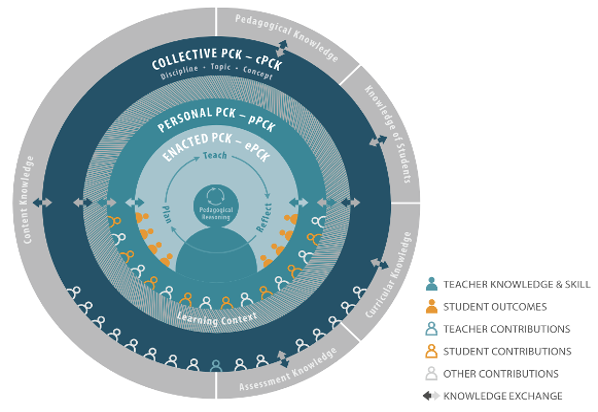
What follows is something I wrote a few months ago. It started as an analytic memo that I wrote during my Ed.D. Capstone research, but it ended up as a bit of a side-trail from my research focus. Those who are a little familiar with my recent research interests will recognize the familiar topic of Pedagogical Content Knowledge, or PCK. Those who read my recent article in the TIE Newsletter will also recognize the description of the Refined Consensus Model of PCK as a model of teacher professional knowledge and professional learning. While in previous writing, I’ve focused on the “bottom-up” knowledge construction about teaching by teachers, in this post I note that teacher professional knowledge develops in both directions, from the “inside-out,” but also from the “outside-in.”

“Metaphor”: An apt metaphor for teaching
I’ve recently been conducting case study research with a few secondary-level English and social studies teachers. A component of my research involves lesson observations and interviews with these teachers, in which I prompt them to share their thinking about their pedagogical decisions. I’m trying to better understand their pedagogical reasoning in planning and implementing their lessons. One of these teachers is a high school English teacher; let’s call her Ms. Bhatti. Ms. Bhatti uses the concept of metaphor as an organizing big idea for teaching her high school English class. Like a good English teacher, for Ms. Bhatti, metaphor is a figure of speech, but metaphors are also a broader literary device.
Content Representations (CoRes) as a Tool for Pedagogical Reasoning
Working with pre-service teachers, Loughran et al. (2004) wanted to develop a tool that would help students of teaching develop this practice of pedagogical reasoning. They hypothesized that a tool that would force teachers to engage in pedagogical reasoning would facilitate both the enactment of teacher PCK, and the development of it. Through various empirical studies, Loughran et al. (2004) developed a tool that they referred to as “Content Representations,” which they named “CoRes” for short. CoRes has since been used by other researchers as a tool for both for measuring PCK, and for developing it, both in pre-service and in-service teachers.
I’m currently conducting some case study research with several secondary teachers, exploring the value of a particular model for developing teacher PCK. I’m using the CoRes tool as part of the model. In an effort to gain more experience with the tool myself, I recently worked through it with a common topic of a high school introductory economics course. It’s worth noting upfront that, though I’ve ended up teaching economics, I studied very little economics in university. Therefore, if I have any readers who are true economists, I hope you’ll forgive any spots in my example that betray my lack of academic economics background.

ChatGPT for Teachers: The Risk of Off-Loading Pedagogical Reasoning
I have concerns about the accelerating roll-out of generative AI systems in education. Many of these concerns relate to uncritical student use of AI tools, but I’m also skeptical about the implications of these tools for teachers.
This week, Open AI released ChatGPT for Teachers. According to Open AI, ChatGPT for Teachers is built upon ChatGPT 5.1 (the version available publicly through paid subscription), but specifically with teachers and school leaders in mind. It’s designed to work seamlessly with tools and software that teachers already use, facilitate collaboration with colleagues, and provide examples from other teachers. Supposedly, it’s built with teacher-specific tasks in mind, and is data privacy compliant with US FERPA rules for student data. I must confess upfront that I have not used it. It’s currently only available to verified K-12 teachers in the US (Open AI has rolled it out free for US-based K-12 teachers through June 2027). I will note that my paid subscription to ChatGPT has given me access to version 5.1 since it was released on Nov. 12 (and to version 5.0 before that). I will also note that I recently spent some time playing with Khanmigo’s AI teaching assistant for teachers, which is built upon the 4.0 version of the ChatGPT LLM system.

Example Sequence of Teacher PD Workshop Lessons
I recently had a couple of discussions with schools here in Rwanda regarding how I might be able to support teacher professional learning (aka. professional development) in the coming school-year. I feel strongly that effective teacher professional learning needs to consider the context of the teachers, school, students, curriculum, etc. However, for the sake of discussion, I put together a rough example sequence of workshop sessions. These are based on my personal teaching experience, and my experience working and observing in schools. The below sequence reflects some of the topics and concepts that I believe are high impact for teacher professional growth and student learning. Again, though, this is just an example.

The Teacher’s Job is to Explain— To “Make Plain”
I have made the claim before that a teacher is essentially an “explainer.” I’ve sometimes felt some resistance from others to that claim, and I think I know why. When I state that a teacher is an “explainer,” for some it conjurers up an image of a dry, boring lecture such as the case of the economics teacher (played by Ben Stein) in Ferris Bueller's Day Off (“anyone, anyone…”). This is not my idea of an “explainer,” so let me try to “explain” my claim below.
Subscribe to the blog.
Like what you’re reading? When you sign up you’ll receive an email each time a new blog article is posted.