
Part 2 of My Reflections on Ed Tech and Horvath’s Book The Digital Delusion
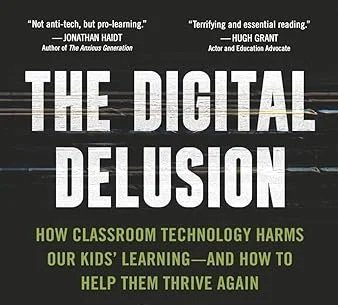
Cover image of The Digital Delusion by Jared Cooney Horvath.
Previously I wrote some reflections on the role of Ed Tech; those reflections were largely my own, but they were definitely inspired, in part, by my recent reading of Jared Cooney Horvath’s book, The Digital Delusion. In that previous post, I stated that, though I’m not convinced by all of his arguments, I definitely recommend Horvath’s book as a corrective to the aggressive push of digital technology, especially AI-based tech tools, into education. Despite my overall appreciation for the book, there is a subtle aspect that I want to push back on in this follow up post.
Reclaiming Progressive Education
In my last post I was critical of progressive schools and educators for embracing Ed Tech uncritically. They did this, I argued, largely because of the influence of neoliberalism on progressive spaces, including education. Despite my critique, I also noted that I call myself a progressive educator, in the sense that I think we need to recognize the problems with how we’ve done schooling in the past and present, and look forward to improve teaching and learning in schools. I feel that this also requires educators to consider the challenges of the world today and to work to ensure that the students in our classrooms are equipped to face those challenges.
Where I Want to Push Back
Though I agree with much of his critique of Ed Tech, Horvath’s vision for how to do education better contains a subtle reactionary tone. I first picked up on this political stance before I read the book. Horvath, in an interview with Drew Perkins on his Thought Stretchers Podcast, made mention that he felt that the 1990s and early 2000s, when he was coming up through secondary school, were “peak western education”. I found this a very odd claim. I am also a product of “western education” in the 1990s. I graduated from high school in Canada in 1998. I’m not so sure everyone had the same “peak” experience.
I understand Horvath’s point. He’s pointing to the 1990s and early 2000s as the era prior to the influence of digital technology in K-12 schools. Yes, the internet existed in the 1990s, but it was still largely the slow, dail-up version, and access to internet-connected computers in K-12 schools was limited, and when it did exist, it was restricted to designated computer labs or the library (I took at typing class in 10th grade in 1995 and still learned on an electric typewriter). This was the era prior to widespread mobile phone use, social media, and smart phones. In schools, this was before one-to-one laptop initiatives and constant, high-speed internet connectivity; it preceded the influence of Ed Tech as Horvath defines it. In other words, Horvath sees this as the pinnacle of western education because it was the last period before the widespread influence of Ed Tech.
This all aligns with his argument about digital technology in education, but I’m uncomfortable with Horvath’s backward-looking perspective, pegging the 1990s as the ideal time of K-12 education, and subtly suggesting that we need to return to that era. This strikes me as a bit of a MEGA — “Make Education Great Again” — sort of claim; a claim that idealizes and fictionalizes an era of the past because it was great for certain groups of people, glossing over the problems of that period for many others. The 1990s may have been a great time in school for Horvath, but that doesn’t mean it was great for all.
Horvath’s Part 2
In part 2 of the book, Horvath dives into some special Ed Tech cases. He first investigates the problems of smartphones, and then tackles AI. In chapter 6, he explores three mechanisms by which AI harms student learning. First he explains the problem of cognitive offloading and then the issue of developing higher order thinking skills. His third harmful mechanism may not be strictly academic, but Horvath feels it’s important to discuss. He believes that AI use by children and adolescents will accelerate the identity formation issues already evident because of social media. He believes young people will increasingly “outsourc[e] their self-development, relying ever more on external opinion to construct their identity.” With social media, young people seek personal value through the approval from others of the curated self they post online. Horvath fears that with AI, what young people project into the internet, as they search for external validation of an identity, will be more and more an AI generated product, further alienating young people from the process of forging their own identity.
I think Horvath’s critiques are compelling when it comes to the harms of smartphones, social media, and AI on child and adolescent cognitive and psychosocial development. It’s no wonder that one of the endorsement blurbs at the front of the book comes from Jonathan Haidt, author of The Anxious Generation. But in chapter 7, Horvath wants us to “step with [him] into deeper water;” he draws on the work of media theorist, Neil Postman, and discusses what he sees as the deeper ideological problem of Ed Tech, specifically AI. He argues that tech advocates believe AI can transform education so that each student can fully control their own learning process, accessing all the information they need, and using AI tools to help them make sense of that information, to “create their own coherence.” Horvath argues that this ideology of atomized coherence-making will accelerate the loss of any shared sense of reality.
Horvath argues that schools need to reclaim their role, not just in sharing information, but in creating collective coherence for the students. He writes: “Schools exist to help students built a coherent, shared worldview; to organize knowledge in ways that allow culture to grow, evolve, and endure.” A few pages later, he writes: “In the face of informational overload, the glue that holds cultures together is a shared reference point; a unified framework for sifting experience and assigning common meaning.” He goes on, “That is what schools have long provided: a structured narrative that unites individuals from all backgrounds into a coherent functioning society.” While I agree with Horvath that our technology use has contributed to the fracturing of a common sense of social reality, I fear that his view of the social role of schools in the past is a reactionary fiction. The 1990s may have been a time where he felt that schools brought people of different backgrounds together “into a coherent functioning society,” but this is probably because he fit into the dominant narrative imposed by schools, and was thus unaware of how schools marginalized many other groups.
A Postmodern Critique of the Grand-Narrative
There are debates about what is meant by postmodernism and whether or not it’s really a thing, but I’m going to make use of the postmodern critique — specifically, a critical postmodernism — of modernism as an analytic framework for my push-back on Horvath’s chapter 7. One of the key features of postmodernism that distinguishes it from modernism is its suspicion of grand-narratives that attempt to make meaning in universalist terms. In this context, a narrative refers to a shared framework — or story — that people use to make sense of and explain the world around them. A grand-narrative seeks to explain everything for everyone as a fundamental, universal truth about the way things are.
Postmodernists emphasize that this human process of sense-making — coherence-making, as Horvath puts it — is always filtered through our human perceptions and cultures; our narratives about the world are constructed, contingent, and contextual. For critical postmodernists, the modernist grand-narrative project, rather than uncovering universal truth, is a political task of imposing a explanation of the world constructed by the dominant power structure that justifies and maintains that dominant structure. Modernist grand-narratives function by suppressing other narratives; they exists only by expunging or marginalizing other stories, histories, cultures, epistemologies, and ways of being.
It’s probably fair to point out that the multiple- and partial-narrative approach of postmodernism, when taken too far, may carry some blame for the erosion of a shared sense of social reality; this is definitely a problem of our times. However, I’m not convinced that the solution is to return to an imposed single grand-narrative that erases the voices, stories, and knowledges of the less powerful. This is where I feel that Horvath’s vision is a reactionary one; his solution seems to be one that looks back to the era of the grand-narrative, when schools attempted to impose a single version of social reality, a dominant narrative that benefited the powerful while marginalizing others.
A Progressive Educator’s Critique of Ed Tech
While I agree with much of Horvath’s argument regarding Ed Tech, and though I recognize that progressive education has tended to uncritically acquiesce to Ed Tech, my hope is for progressive education to discover, in the face of the current AI onslaught, a forward-looking and humane picture of teaching and learning. I fear that Horvath’s ideal depends too much on a nostalgia for an era in education that may have benefited some, but did so by marginalizing others. The world is full of these nostalgic responses to neoliberalism right now; I believe these reactionary paths are dangerous, both in politics largely and in education. What I hope for are progressive visions (given postmodernism, we can’t have a single vision) of education that evaluate technology critically, refuse the insistence from Ed Tech that education is better served by algorithms and AI, reject the neoliberal argument that schools are only about developing skills for the future world of work, and double-down on education as a human, social endeavor of improving life on this planet— human life within healthy ecologies. In my view, there are many things about this new era of Generative AI that run counter to those progressive visions. For this reason, I’m wary of the role of Gen AI in education, and in this, Horvath and I are in agreement.
